


CO2 shipping - the value chain moved forward through 2025

As 2025 drew to a close, Finland’s Vantaan Energia’s Vantaa Carbon Capture project was announced, described as Finland’s first industrial-scale carbon dioxide capture and storage project and as creating “a completely new infrastructure and value chain for carbon dioxide capture, utilisation and storage in Finland.”
According to the company, the project would “significantly reduce fossil emissions and create a value chain in Finland that enables new business.”
Vantaan Energia and the Port of Helsinki have agreed liquefaction, intermediate storage and shipping would take place at Vuosaari Harbour, with carbon dioxide captured at the Vantaa waste-to-energy plant and transported to the port for liquefaction before loading onto ships for permanent storage in geological formations in the North Sea, procured as a service.
The Vuosaari announcement sat alongside other Scandinavian developments in 2025, with Norway’s Northern Lights project commencing CO2 injection in 2025, and on course to double its storage capacity, underlining how shipping-based systems are moving from concept into early operation and expansion.
In Stockholm, Stockholm Exergi has overcome regulatory hurdles for CO2 shipping by 2028, with an agreement finalised alongside a final investment decision.
Around the North Sea and UK Continental Shelf, 2025 brought a cluster of capture and storage news with direct implications for future CO2 shipping demand.
Testing was underway on the UK’s first CO2 capture and storage project and Eni committed to a UK carbon capture project, awarding Saipem a contract valued at US$590M.
Meanwhile, Europe saw the launch of Carbon Destroyer 1 as a step in EU CCS deployment, and in the Mediterranean, CO2 capture and storage is close to starting.
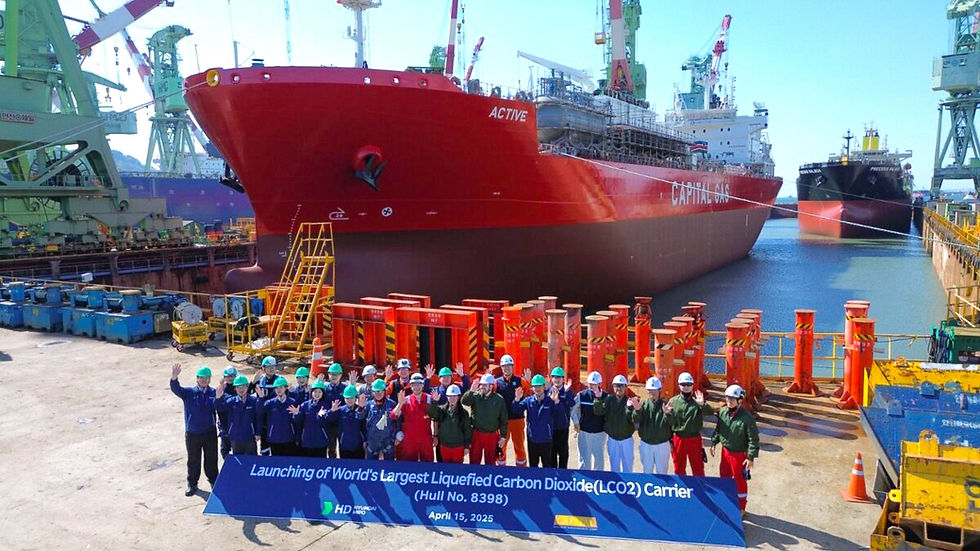
Shipping hardware and floating infrastructure also advanced, with the launch at HD Hyundai of what was described as the world’s largest liquefied CO2 carrier for Capital Gas, signalling dedicated LCO2 tonnage is moving into the water rather than remaining on drawing boards.
Floating storage and injection concepts gained momentum such as NYK, KNCC and ENEOS Xplora’s development of a floating CO2 storage unit and a proposal from MOL and MODEC for an offshore LCO2 unit.
Yinson, K Line and Provaris were also reported to be planning advances in CO2 shipping, pointing to an emerging portfolio of offshore and near-shore solutions designed to connect emitters with storage where subsea pipelines are not immediately available.
Elsewhere, Petrobras’ approval of a CCS saline reservoir pilot in Brazil added a South American dimension to the evolving picture.
But regulatory challenges remain in 2025: Intertanko managing director Tim Wilkins highlighted what he called a “slight shortcoming” in the London Protocol regarding the framework for bilateral agreements, and said members would have greater confidence with a clearer framework for CO2 as cargo rather than waste.
He also warned the EU focus on intra-EU transport sat uneasily with evidence that the bloc lacked storage capacity, and he argued extra-EU CO2 shipping would be essential.
He cautioned if CO2 transport by ship is not recognised as a legitimate form of export, “the risks associated with ordering an LCO2 carrier increase significantly” and regulatory uncertainty could deter investment.
source: riviera news (Craig Jallal)


